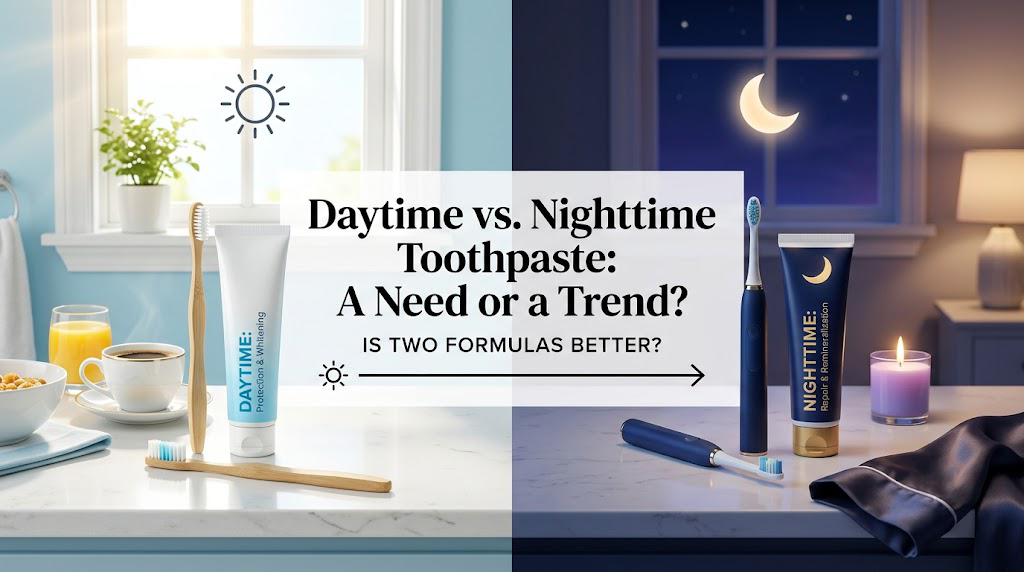
If you have strolled down the oral care aisle recently or scrolled through wellness trends online, you may have noticed a shift in how we care for our teeth. Brushing twice a day used to mean squeezing the exact same strip of paste onto your toothbrush morning and night. Today, however, oral care brands are introducing dedicated dual-formula regimens: one tube specially engineered for your morning routine and another formulated for when you wind down before bed.
This brings up a natural question: Is the concept of daytime vs nighttime toothpaste a legitimate advancement in dental health, or is it simply a clever marketing strategy designed to get consumers to buy twice as much product?
To understand whether split formulas offer genuine benefits, we need to take a closer look at how your mouth’s environment changes over a 24-hour cycle and what different ingredients actually accomplish.
Your Mouth’s Internal Clock: The Biological Shift
Our bodies operate on a circadian rhythm, and our oral cavity is no exception. Throughout the day and night, the environment inside your mouth experiences significant physiological biological shifts—primarily driven by one critical factor: saliva production.
During the daytime, your salivary glands are active. Saliva acts as your mouth’s natural defense mechanism. It washes away stray food particles, buffers harmful acids produced by plaque bacteria, and delivers essential minerals like calcium and phosphate back into your enamel. Furthermore, during waking hours, you consume various foods, acidic coffee, sugary snacks, and stain-causing beverages.
At night, however, saliva flow drops dramatically as you sleep. A drier mouth creates an ideal environment for anaerobic bacteria to multiply. Without continuous salivary flow to neutralize acids and wash away microbes, bacteria metabolize residual carbohydrates, producing acids that erode enamel and contribute to morning breath, plaque accumulation, and gum irritation.
Given these distinct biological environments, the argument for tailored formulas becomes clearer.
The Focus of Daytime Toothpastes: Protection, Whitening, and Freshness
Daytime toothpaste is engineered to prepare your teeth for the daily environmental stressors they are about to face. Throughout the day, your teeth encounter staining agents (like tea, wine, and berries) and acid spikes from meals.
Most daytime formulas focus on three primary goals:
- Stain Prevention and Removal: Daytime formulas often contain mild abrasives (such as hydrated silica) or gentle stain-dissolving agents that polish teeth and prevent surface stains from settling.
- Enamel Shielding: Ingredients like active fluoride or micro-hydroxyapatite help fortify the enamel against acid attacks from breakfast, lunch, and mid-day snacks.
- Vibrant Freshness: Morning formulas frequently incorporate higher concentrations of peppermint, spearmint, or citrus oils to awaken your senses and combat morning breath.
Because daytime formulas prioritize defense and surface aesthetics, they provide an invigorating start to your day while shielding enamel from daily dietary habits.
The Focus of Nighttime Toothpastes: Deep Repair and Microbe Control
Nighttime toothpaste shifts the focus from active defense to deep restoration and overnight protection. Because your mouth stays closed and saliva production slows down for six to eight hours, nighttime formulas work under quiet conditions where ingredients have extended contact time.
Key features of nighttime formulas include:
- Antibacterial and Plaque Defense: Since bacteria thrive in dry, dark environments, nighttime pastes often feature soothing, non-irritating antibacterial compounds or zinc minerals to inhibit bacterial proliferation overnight.
- Deep Enamel Remineralization: High concentrations of remineralizing agents work undisturbed overnight, helping to repair microscopic enamel wear sustained throughout the day.
- Gentle, SLS-Free Formulations: Many nighttime pastes omit aggressive foaming agents like Sodium Lauryl Sulfate (SLS). Reducing SLS helps maintain mucosal hydration, preventing nighttime dry mouth and aphthous ulcers.
- Soothing Botanical Extracts: Instead of intense mint, nighttime variants frequently utilize milder, calming flavors such as chamomile, lavender, or subtle herbal mint to encourage relaxation before sleep.
Daytime vs Nighttime Toothpaste: Marketing Hype or Essential Routine?
When weighing the debate surrounding daytime vs nighttime toothpaste, the truth lies somewhere in the middle.
From a strict clinical standpoint, brushing twice a day with a single, high-quality fluoride or hydroxyapatite toothpaste approved by the American Dental Association is fully sufficient to maintain healthy teeth and gums. If your primary goal is basic disease prevention and plaque control, two separate tubes are not strictly mandatory.
However, utilizing tailored formulas offers distinct functional advantages. Matching specific active ingredients to your mouth’s natural circadian rhythm optimizes your oral care strategy. A morning toothpaste shields against acids and stains, while an evening toothpaste focuses on remineralization and bacterial suppression during dry-mouth hours.
If you suffer from specific concerns—such as chronic dry mouth at night, stubborn enamel sensitivity, or frequent coffee staining—adopting a dual-formula system can significantly enhance your results. Exploring different specialized toothpaste options allows you to customize your routine based on your precise oral care needs.
How to Build the Ideal Oral Care Regimen
If you decide to try a split routine, keep these simple guidelines in mind:
- Morning Routine: Choose a formula with antioxidant protection, mild polishing agents, and fluoride or hydroxyapatite to strengthen enamel against daytime acids.
- Evening Routine: Choose a gentle, SLS-free formula focused on remineralization, gum hydration, and long-lasting antibacterial action.
- Consistency Trumps Everything: Whether you use one universal formula or split your routine into two distinct products, brushing thoroughly for two full minutes twice daily—along with daily flossing—remains the undisputed cornerstone of lifelong dental health.
Final Verdict
So, is there a genuine need for two separate toothpaste formulas? While it isn’t an absolute clinical necessity, the debate over daytime vs nighttime toothpaste highlights an important truth: your oral hygiene requirements change from day to night. Utilizing target-specific formulas leverages your body’s natural rhythms to deliver maximum protection during the day and targeted repair while you sleep.