For decades, sodium lauryl sulfate (SLS) served as the primary surfactant in personal care products. However, growing consumer awareness regarding oral mucosal irritation, aphthous ulcers (canker sores), and tissue dryness has driven a massive shift toward gentler alternatives. Two gentle, plant-derived surfactants dominate modern oral care formulations: Coco-Glucoside and Cocamidopropyl Betaine (CAPB). Brands frequently choose between these options to replace harsher sulfates.
Understanding coco-glucoside vs cocamidopropyl betaine in toothpaste helps formulators achieve strong cleansing power without compromising oral health. Both ingredients are milder alternatives to traditional sulfates. However, they differ significantly in chemical structure, foaming behavior, and safety.
Understanding the Role of Surfactants in Oral Care Formulations
Surfactants, or foaming agents, fulfill several critical functions in toothpaste:
- Surface Tension Reduction: They lower water surface tension and help the toothpaste spread evenly over teeth and gums.
- Debris Removal: They break down food particles, plaque, and debris so they rinse away easily.
- Flavor Dispersion: They help mix essential oils and flavors into water-based formulations.
- Sensory Experience: Foam provides the tactile sensation of effective cleaning that consumers expect from their daily routine.
Traditional surfactants like SLS produce rich foam. However, their aggressive cleansing can strip protective layers inside the mouth. This has led manufacturers to evaluate milder non-ionic and amphoteric surfactants.
What Is Coco-Glucoside in Oral Care?
Coco-Glucoside is a mild, non-ionic surfactant. Manufacturers produce it by combining plant glucose with fatty alcohols from coconut oil.
Key Characteristics of Coco-Glucoside
- Chemical Nature: Non-ionic, meaning it carries no electrical charge. This makes it highly mild and stable alongside other formulation ingredients.
- Biocompatibility: Highly biodegradable, non-irritating to mucous membranes, and free from toxic residues.
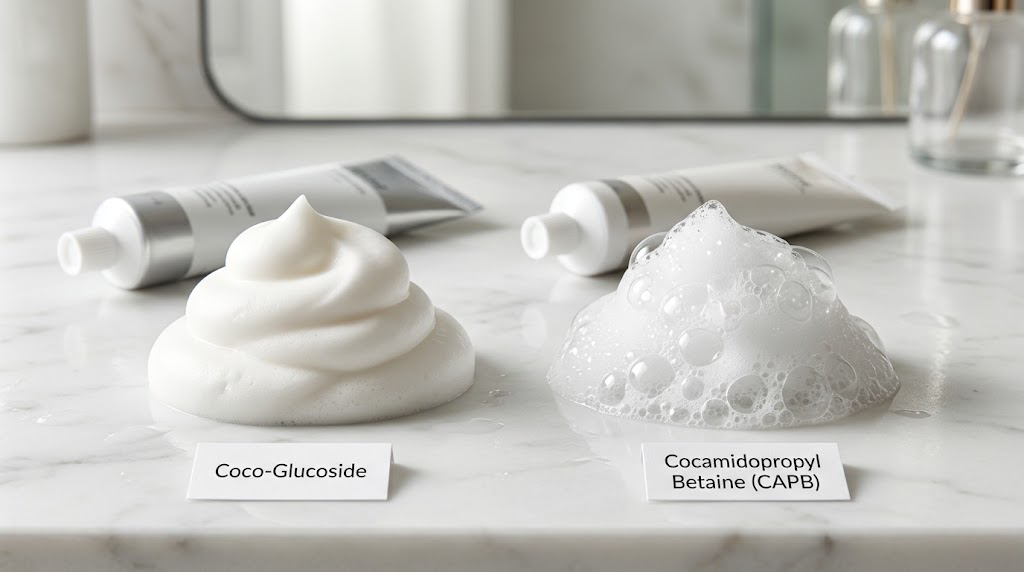
- Foam Profile: Produces a dense, stable, creamy foam rather than high-volume airy bubbles.
With no electrical charge, Coco-Glucoside works safely with active ingredients and delicate mouth tissues. This makes it perfect for sensitive teeth formulations.
What Is Cocamidopropyl Betaine (CAPB)?
Cocamidopropyl Betaine is an amphoteric (zwitterionic) surfactant derived from coconut oil and dimethylaminopropylamine (DMAPA).
Key Characteristics of Cocamidopropyl Betaine (CAPB)
- Chemical Nature: Amphoteric, carrying both positive and negative charges depending on the pH of the formulation.
- Foam Profile: Generates quick, high-volume lather similar to traditional sulfates.
- Conditioning Properties: Provides a smooth mouthfeel and reduces the irritancy of harsher secondary surfactants when blended.
CAPB is significantly gentler than SLS. However, it can occasionally cause allergic reactions due to trace impurities like free amidoamine and DMAPA.
Analyzing Coco-Glucoside vs Cocamidopropyl Betaine in Toothpaste Formulations
To evaluate coco-glucoside vs cocamidopropyl betaine in toothpaste, formulators examine four key performance metrics: foaming capacity, mucosal compatibility, stability, and taste impact.
| Performance Metric | Coco-Glucoside (Non-Ionic) | Cocamidopropyl Betaine (Amphoteric) |
| Foam Quality | Dense, creamy, fine-bubbled | Airy, high-volume, quick-blooming |
| Mucosal Mildness | Extremely mild; lowest irritation risk | Mild; minor risk of contact allergy |
| Flavor Impact | Mild naturally sweet taste; easy to mask | Slightly bitter/salty; requires flavor optimization |
| Active Compatibility | Compatible with remineralizing agents | Compatible across standard pH ranges |
1. Foaming Dynamics and Sensory Appeal of Mild Surfactants
Consumers often equate abundant lather with cleaning efficacy. CAPB produces rapid, voluminous foam that closely mimics the sensory feel of conventional SLS toothpastes. In contrast, Coco-Glucoside creates a rich, micro-bubble lather. While less voluminous, Coco-Glucoside’s creamy foam lingers longer during brushing, offering superior coverage.
2. Oral Mucosal Compatibility and Allergens: Coco-Glucoside vs CAPB
When comparing coco-glucoside vs cocamidopropyl betaine in toothpaste for sensitive users, Coco-Glucoside holds a slight edge. As a pure alkyl glucoside, it lacks the nitrogenous impurities found in synthetic amidoamines. ADA guidelines recommend avoiding mouth irritants to prevent recurrent mouth sores. This makes non-ionic surfactants a great choice for patients prone to ulcers.
3. Taste and Flavor Neutrality in Toothpaste Formulations
Flavoring oral care products is well known to be challenging. CAPB presents a mild soapy or bitter undertone that requires careful masking with peppermint or cooling agents. Coco-Glucoside exhibits a neutral sensory profile with subtle sweetness. This allows formulators to use less sweetener while keeping a fresh flavor.
Formulating Toothpaste for Optimal Cleansing Performance
Rather than choosing one exclusively, modern oral care research often combines surfactants to achieve synergistic benefits. Pairing Coco-Glucoside with secondary mild ingredients enhances foam density while keeping the overall irritation index near zero.
Visit our toothpaste product catalog to explore our latest formulations.
Final Verdict: Which Toothpaste Foaming Agent Fits Your Product?
Both surfactants represent a major upgrade over traditional SLS in natural and sensitive oral care applications:
- Select Coco-Glucoside for maximum mildness, a neutral taste, and sensitive mouth formulas. It also meets natural standards like COSMOS and Ecocert.
- Select Cocamidopropyl Betaine if you aim to match the high-foaming expectations of traditional toothpaste users while significantly reducing mucosal harshness compared to sulfates.
By carefully weighing these properties, brand owners and formulators can craft toothpastes that deliver outstanding cleansing power, excellent consumer satisfaction, and superior oral comfort.