In oral care formulation, selecting the right rheology modifier or binder is critical to the end-user experience. Hydrocolloids provide toothpaste structure, controlling smooth flow, ribbon shape, and formula stability over time. Among the most widely used thickening agents, Xanthan Gum and Sodium Carboxymethyl Cellulose (CMC) remain the industry standards.
Understanding the trade-offs between xanthan gum vs cmc in toothpaste is essential for manufacturers. It allows them to optimize paste texture, salt compatibility, production costs, and overall shelf life.
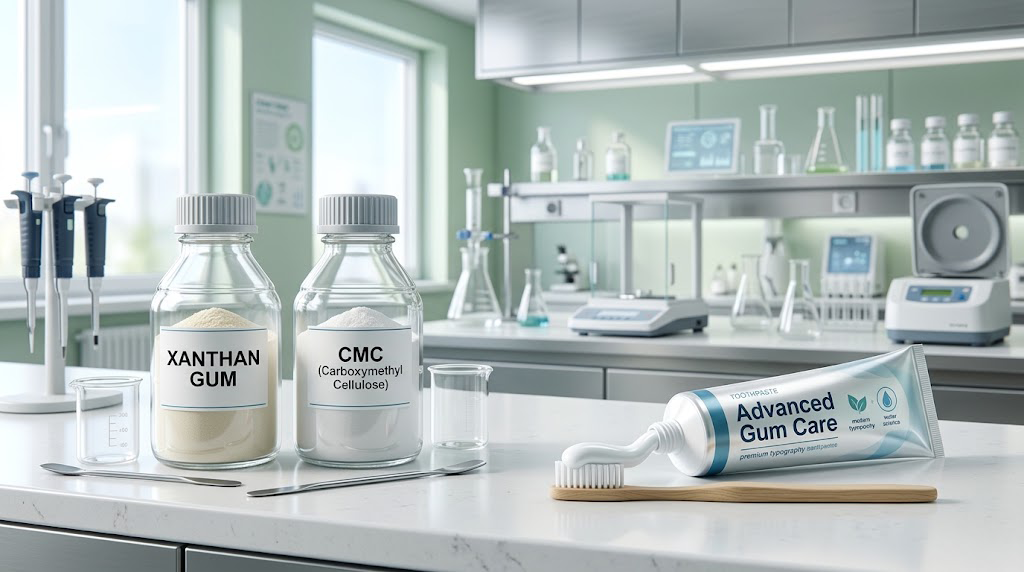
Comparing Hydrocolloid Performance: Xanthan Gum vs CMC in Toothpaste Formulations
Formulators must compare key physical properties when evaluating xanthan gum vs cmc in toothpaste. They need to look closely at flow behavior, salt tolerance, heat stability, and raw material costs. Both hydrocolloids act as effective binders, but their molecular structures create distinct user experiences and processing profiles.
| Performance Parameter | Xanthan Gum | Sodium Carboxymethyl Cellulose (CMC) |
| Flow Profile | Highly Pseudoplastic (Shear-Thinning) | Thixotropic (Time-Dependent Flow) |
| Ribbon Stand-Up | Excellent (Sharp Yield Value) | Moderate to Good (Slightly Soft) |
| Electrolyte Tolerance | High (Stable with Active Salts) | Moderate (Sensitive to Divalent Ions) |
| Cost Efficiency | Medium to High | Highly Cost-Effective |
| Rinsability & Mouthfeel | Clean, Fast Dispersal | Smooth, Creamy Residual Texture |
Technical Performance Breakdown: Xanthan Gum vs CMC in Toothpaste
+--------------------------------------------------------------------------+
|                  RHEOLOGICAL BEHAVIOR IN DENTAL PASTES                   |
+--------------------------------------------------------------------------+
|                                                                          |
|  XANTHAN GUM                                                             |
|  High Shear Stress  =====================> Low Viscosity (Easy Extrusion)|
|  Zero Shear Stress  =====================> High Yield (Sharp Stand-Up)   |
|                                                                          |
|  SODIUM CMC                                                              |
|  Agitation/Rest     =====================> Time-Dependent Viscosity      |
|                                            (Creamy, Smooth Ribbons)      |
+--------------------------------------------------------------------------+
1. Rheology and Shear Response
Xanthan gum exhibits strong shear-thinning behavior. Under the shear stress of squeezing a tube, its viscosity drops rapidly, allowing easy dispense through small orifice nozzles. Once the pressure stops, it instantly recovers its structure, providing crisp ribbon shape retention on bristle tips.
In contrast, CMC typically displays thixotropic behavior. It flows smoothly under pressure, yielding a classic, creamy string when applied to the brush. However, its structural recovery takes a little extra time. Without synthetic silicas, this delay can make the paste ribbon slightly soft.
2. Electrolyte and Active Compatibility
Toothpaste formulations frequently contain active ingredients, humectants, and anti-caries agents. The American Dental Association highlights several essential ingredients for oral health. Active agents like sodium fluoride, stannous fluoride, and zinc salts help prevent decay and strengthen enamel.
- Xanthan Gum: Exhibits exceptional stability across broad pH ranges and high ionic strength environments. It remains fully stable in high-salt pastes (such as potassium nitrate sensitivity formulas or saline whitening pastes).
- CMC: An anionic polymer derived from cellulose. High levels of calcium or zinc ions, as well as low pH, can cause CMC to lose viscosity or precipitate. Therefore, formulators must maintain precise pH buffer control.
3. Thermal and Storage Stability
During global transport, paste tubes experience significant temperature fluctuations. Xanthan gum maintains constant viscosity across temperatures from 4°C to 70°C. CMC viscosity drops as temperatures rise. In warm climates, an unbalanced binder system can lead to phase separation or liquid bleeding.
Commercial Considerations for Xanthan Gum and CMC Formulations
For contract manufacturers and brand owners developing custom lines, balancing cost and sensory appeal is crucial:
- Economic Value: CMC offers a low price per kilogram. This makes it an ideal binder for high-volume, mass-market toothpastes. Xanthan gum has a higher raw material price. However, its high efficiency requires lower usage levels—typically 0.3% to 0.8%, compared to 0.8% to 1.5% for CMC.
- Synergistic Blends: Modern oral care labs rarely rely on a single hydrocolloid. Formulators often combine CMC with small amounts of xanthan gum. This combination keeps CMC’s smooth paste texture while using xanthan gum to stop abrasive particles from settling.
- Natural and Organic Certification: Both gums meet natural cosmetic standards like COSMOS and ECOCERT. However, natural or “clean label” formulations often favor fermentation-derived xanthan gum.
Conclusion: Selecting Xanthan Gum vs CMC for Your Toothpaste
Choosing between xanthan gum vs cmc in toothpaste ultimately depends on your target market, active ingredients, and price point. For standard fluoride pastes with tight cost targets, CMC offers a creamy texture and dependable structure. Xanthan gum offers superior stability and flow control for therapeutic, high-salt, or natural gel toothpastes.
To explore advanced oral care formulations and ready-to-market oral hygiene solutions, visit our toothpaste product categories.