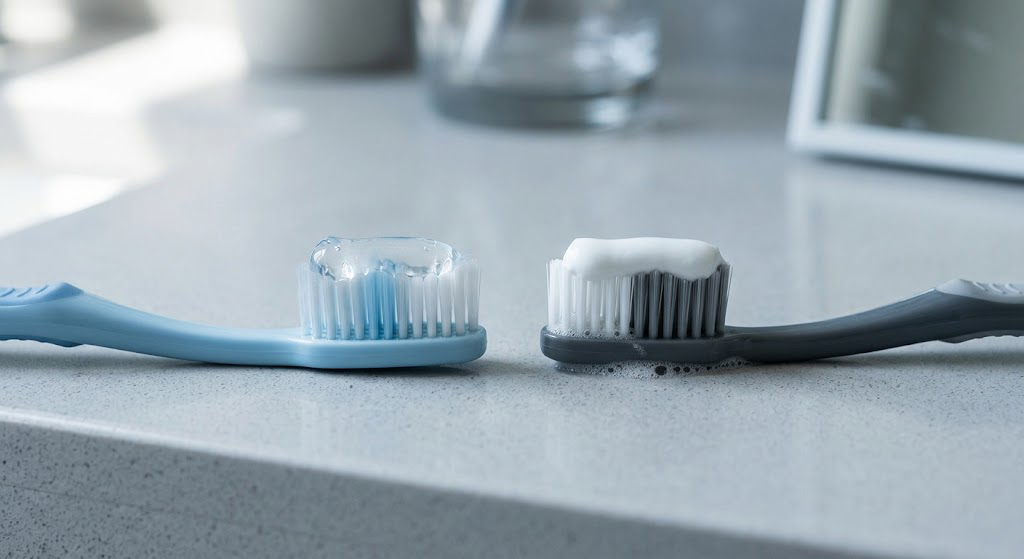
When shopping for toothpaste, most consumers choose between a clear gel and a white paste based on look, feel, or flavor. However, from a chemical engineering perspective, the decision involves distinct physical and chemical paradigms. Understanding clear gel vs opaque toothpaste requires a deep dive into rheology, light scattering, and abrasive chemistry. Both toothpastes effectively deliver fluoride to your teeth, but they rely on completely different manufacturing strategies.
| Formulation Parameter | Clear Gel Toothpaste | Opaque Toothpaste |
| Optical Appearance | Transparent / Translucent | Opaque White or Colored Solid |
| Light Scattering | Minimized via RI matching | High forward & backward scattering |
| Primary Abrasive | Hydrated Silica (Low RI) | Calcium Carbonate, Dicalcium Phos. |
| Opacifier / Pigment | Absent (or subtle micro-pearls) | Titanium Dioxide (TiO₂) |
| Humectant Ratio | High (Glycerin, Sorbitol >50%) | Moderate (typically 20-40%) |
1. Light Scattering: Clear Gel vs. Opaque Toothpaste Optical Science
The key difference comes down to how light passes through the inner ingredients of the toothpaste.
The Physics of Index Matching
A standard toothpaste is a complex mixture containing liquid humectants, water, solid abrasives, surfactants, and polymers. When light hits ingredients with different refractive indices (RI), it bends and scatters at every border. This scattering makes the mixture look opaque.
- Opaque Formulations: Standard pastes mix water-based liquids with high-refractive-index minerals like calcium carbonate. This sharp jump in refractive index from 1.33 to 1.65 blocks light from passing straight through. The substantial delta in refractive index (Δn ≈ 0.32) forces immediate light scattering. Furthermore, manufacturers add opacifying agents like Titanium Dioxide (n ≈ 2.49) to create a bright white appearance.
- Clear Gel Formulations: To eliminate scattering and achieve transparency, cosmetic chemists must engineer a single-phase optical appearance. This process matches the refractive index of the liquid binder to the solid abrasive. Chemists typically target a shared refractive index around 1.440 to 1.460.
Δn = |n(liquid phase) – n(solid abrasive)| ≈ 0
To prevent light scattering, chemists mix water with high-index humectants, such as glycerin (1.474) and 70% sorbitol (1.458). This matches the liquid base to the solid abrasive so light can pass straight through.
2. Abrasive Selection: Clear Gel vs. Opaque Toothpaste
Formulators build the rest of the toothpaste around their choice of cleaning abrasive.
Hydrated Silica Systems in Gels
Clear gels almost exclusively use synthetic hydrated silica (SiO₂·nH₂O). Manufacturers can customize synthetic silicas during production to adjust their particle size, refractive index, and Relative Dentin Abrasivity (RDA). Silica has a low refractive index between 1.440 and 1.450. As a result, it blends into high-humectant liquid bases without turning the gel opaque.
Chalk and Phosphate Bases in Opaque Pastes
Opaque pastes have greater flexibility regarding raw material selection because index matching is unnecessary. Formulators frequently utilize:
- Precipitated Calcium Carbonate (PCC)
- Dicalcium Phosphate Dihydrate (DCPD)
- Insoluble Sodium Metaphosphate (IMP)
Traditional abrasives clean stains well and cost less. However, their high refractive index keeps them from turning into clear gels.
Formulators optimizing modern oral care lines select these abrasive matrices based on targeted cleaning power, manufacturing budget, and intended visual appeal.
3. Binder Networks: Comparing Gel vs. Opaque Paste Rheology
The thickeners and binders used in toothpaste determine its yield point, ribbon stand-up, and tube extrusion characteristics.
Polymeric Hydrocolloids in Gels
Clear gels require specialized polymer thickeners. These thickeners must dissolve smoothly without trapping micro-bubbles or forming clumps that scatter light. Key thickening agents include:
- Carboxymethyl Cellulose (CMC): Highly refined grades with high purity levels to prevent haziness.
- Synthetic Polymers: Carbomers or Polyvinylpyrrolidone (PVP), which form crystal-clear structures.
- Xanthan Gum: Used selectively, as excess xanthan can create minor turbidities if not processed under high shear.
Clay and Inorganic Thickeners in Opaque Systems
Opaque pastes often use inorganic clays like Magnesium Aluminum Silicate (Veegum) or Bentonite. Formulators combine these clays with standard cellulose gums to build structure. These inorganic solids improve the paste’s shape and heat stability. However, their high density keeps them from working in clear gels.
4. Stability and Active Delivery in Clear Gel vs. Opaque Toothpaste
Both gel and opaque dentifrice bases must comply with strict oral health standards to ensure therapeutic efficacy. A quality toothpaste must reliably deliver active ingredients like sodium fluoride to prevent cavities and reduce plaque. Official guidelines, including those from the American Dental Association, mandate these active components.
Active Ingredient Stability
- Fluoride Ions: Both delivery systems can stabilize active fluoride. Silica-based clear gels maintain fluoride availability better over time. Unlike calcium carbonate, hydrated silica is chemically inert and will not react with free fluoride.
- Surfactant Integration: To achieve a clear gel, formulators must fully dissolve foaming agents like Sodium Lauryl Sulfate (SLS). Any micellar aggregation or phase separation instantly compromises optical clarity, requiring tight control over surfactant concentrations and processing temperatures.
Formulating Clear Gel vs. Opaque Toothpaste for the Future
The technical divergence between clear gel vs opaque toothpaste illustrates how physical optics, particle chemistry, and rheology intersect in consumer product development. Opaque toothpastes provide classic stability and low-cost abrasives. In contrast, clear gels act as precision optical systems where every component matches the same refractive index.
Both toothpaste types effectively deliver key active ingredients. As a result, consumers can simply choose the texture and look they like best.