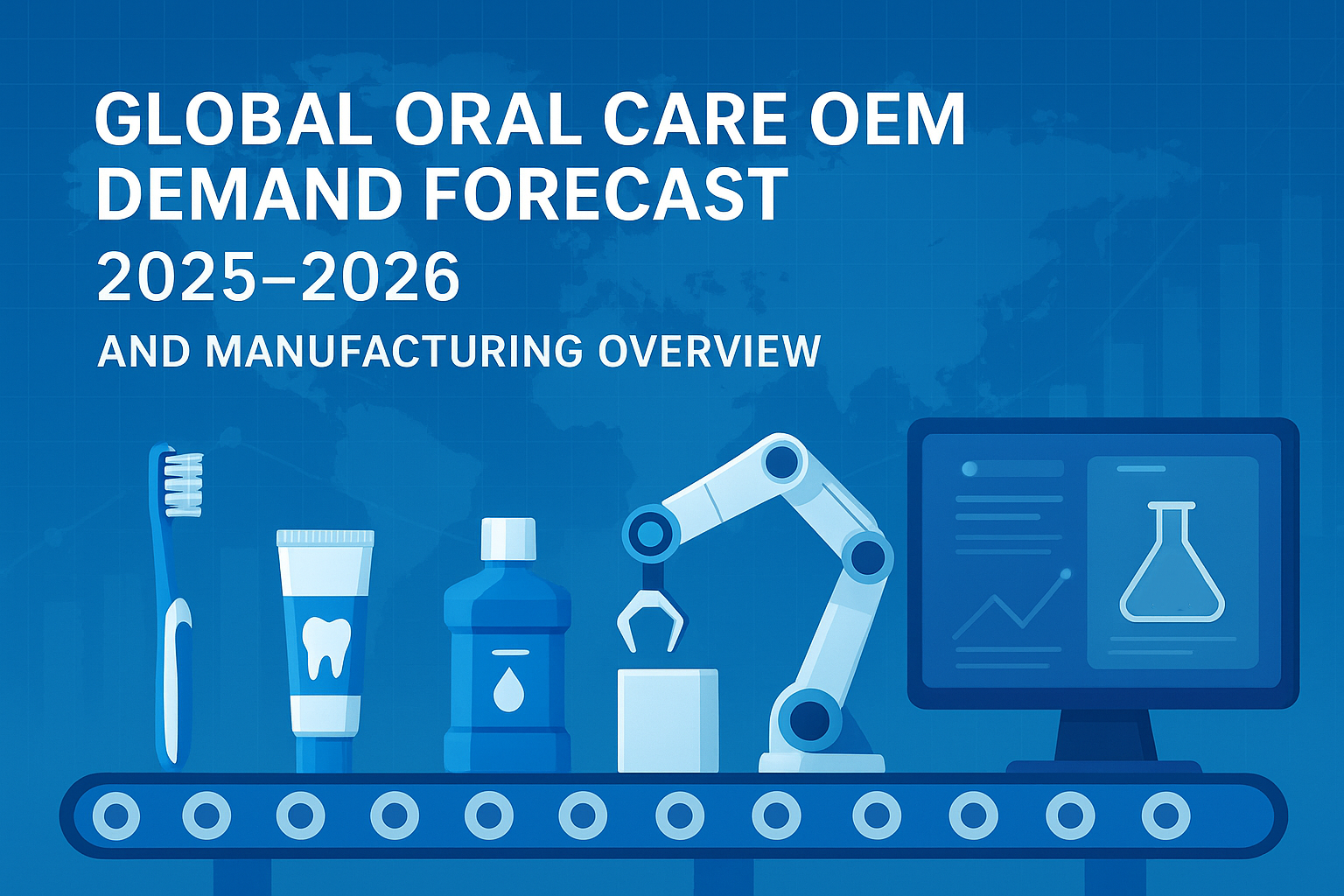
The global oral care OEM demand landscape is undergoing its fastest transformation in a decade. Sustainability regulations are tightening, AI is accelerating formulation innovation, and brand orders are becoming increasingly fragmented. OEM and ODM manufacturers are entering a new phase. In this period, focusing on product differentiation and supply-chain resilience is more important than simply increasing production volume.
Recent reports from Statista, Euromonitor, and Smithers show that the global forecast for 2025–2026 predicts strong growth. However, there are significant disparities between regions and increasing operational challenges.
Oral Care OEM Demand: Core Drivers Behind Market Growth
Personalization Becomes the Next Mass Market
Customization is shifting from a niche marketing tactic to a mainstream procurement requirement. The demand for anti-sensitivity toothpaste is growing by 12% each year. Probiotic mouthwashes, especially those with microbiome-friendly claims, are growing even faster at 18% per year.
Emerging technologies are lowering the barriers for smaller brands. AI simulation tools now cut ODM research and development cycles and costs by up to 30%. This helps boutique labels launch clinical-grade products without needing in-house labs. This alone is accelerating the number of regional private labels relying on ODM support.
Sustainability Regulations Redefine Material Choices
Sustainability is no longer voluntary. The EU will ban traditional non-degradable filament materials in 2026. Analysts expect this change to move 35% of global toothbrush production to bamboo fiber and wheat-straw bristles.
Packaging is also entering a high-innovation phase. Seaweed-based toothpaste tubes have gained support from major corporations like Colgate and Unilever. They have already booked 60% of their planned production capacity through 2026. These material shifts are creating a significant competitive advantage for factories with validated alternative-material supply chains.
Regional Trends in Oral Care OEM Demand and Forecast Divergence
Asia-Pacific—The New Volume Engine
Asia-Pacific remains the fastest-growing region in the oral care OEM demand outlook. India’s online oral care market is growing quickly at 40% each year. This growth creates a supply gap of about 800,000 cartons of toothpaste every month. Localized formulations featuring neem, turmeric, and plant extracts have become mandatory for brand relevance.
North America—Clinical Channels Drive Premiumization
Demand in North America is increasingly clinic-centric. Fluoridated gels, prescription-strength desensitizing pastes, and dental-office-exclusive lines are growing by 25% per year. However, the FDA’s 12–18-month certification cycle represents a significant ODM barrier, creating opportunities for factories with established medical-grade compliance portfolios.
Europe—Eco-Certification as a Competitive Filter
Europe’s drugstores and skin care channels are leading projects across different industries. This includes partnerships between beauty companies and dental brands. EPAA and other sustainability certifications have raised compliance costs by 15%, but they simultaneously boost trust and pricing power. For ODM factories aiming to expand into the EU, proactive certification planning is essential.
Supply-Chain Reconfiguration and Manufacturing Outlook for Oral Care OEMs
Nearshore Production Gains Momentum
Regionalization is reshaping global procurement. Mexico’s ability to make products for U.S. orders has grown by 50%. This shift has reduced delivery lead times from 45 days to just 7 days.
Vietnam’s energy shortages in 2025 caused a 22% delay in toothbrush shipments in Q2. This raised concerns about reliability for buyers who need products on time.
Smart Factories Become the New Standard
Automation is rapidly lowering defect rates and stabilizing output. Leading OEM plants in Dongguan have deployed AI-driven inspection robots, reducing defects from 3% to 0.2%.
Germany’s “Toothbrush 4.0” initiative shows the future. It uses one automated line to produce 200,000 units each day. This also reduces labor costs by 47%.
Opportunity Matrix for Emerging Oral Care OEM/ODM Categories
Low-Risk, High-Potential Categories
Children’s anti-cavity chewable tablets are gaining momentum among pharmaceutical distributors and retailers. Their stability and regulatory simplicity make them ideal for new entrants seeking predictable margins.
Moderate Risk Categories
CBD-based oral sprays and whitening strips remain profitable but face saturation. Whitening strips now exhibit 75% product homogeneity, reducing differentiation potential unless combined with value-added delivery systems or IP-protected formulations.
High-Risk Categories
Nanorobotic plaque-removal solutions may attract attention, but the regulatory pathway is unclear. Meanwhile, sonic toothbrushes continue to face escalating patent disputes, making them a hazardous category for ODM newcomers.
Key Challenges and Strategic Responses for Oral Care OEM Demand in 2026
Rising Compliance Costs
California Proposition 65 now limits 12 more ingredients in toothpaste. This change raises the cost of redesigning formulas by about USD 1.2 million for each product. Centralized testing platforms, like SGS cloud-based global compliance services, are important tools. They help reduce costs for different brands.
Fragmented Orders and Shorter Life Cycles
TikTok-native brands are placing dramatically smaller orders—dropping from 50,000 units per run to just 8,000. In response, modular production lines are becoming standard. Some Dongguan plants have reduced line-switching time from 8 hours to 45 minutes, improving flexibility without sacrificing efficiency.
Global Forecast: Where Oral Care OEM/ODM Demand Is Heading in 2026
The winning OEM/ODM manufacturers will be those able to balance three strategic pillars:
- Technology superiority—such as controlled-release bioactive ingredients.
- Supply-chain resilience—dual-region manufacturing networks.
- ESG leadership—validated carbon-footprint traceability across the full lifecycle.
Analysts expect the global OEM/ODM market to reach USD 28.7 billion. This market will grow at a rate of 9.3% each year. Notably, Southeast Asia will surpass China for the first time, holding 38% of global output while China holds 35%.
Brands should also monitor two major regulatory variables expected in early 2026:
- The EU’s revised Single-Use Plastics Directive
- Brazil’s pending medical device tariff adjustments
Both have the potential to shift procurement patterns significantly.
Guidance for Brands and Procurement Teams on Oral Care OEM Demand
Manufacturers with flexible capacity, validated sustainability materials, and cross-regional production sites will dominate the next procurement cycle. For brands that want stable long-term partnerships, it is important to find certified OEM/ODM providers. These providers should have proven export experience.
Explore OralGos’s OEM service page here for a comprehensive overview of OEM capabilities and customized solutions.
If you need expert guidance on specific projects or sourcing, you can reach their team via the inquiry portal here.
Access authoritative market data and long-term forecasts through Statista’s global industry database here.