Launching a new oral care product requires far more than an appealing flavor profile and eye-catching packaging. For oral hygiene brands and manufacturers, verifying formulation integrity over time is a critical prerequisite to entering the market. Toothpaste stability testing serves as the analytical backbone of product development, ensuring that every tube delivered to consumers maintains its safety, aesthetic appeal, and therapeutic efficacy throughout its intended shelf life.
Without rigorous evaluation, oral care formulations can suffer from phase separation, loss of active ingredients (such as fluoride or whitening agents), flavor degradation, or microbial contamination. Understanding how to structure comprehensive stability protocols allows brand managers and research teams to mitigate financial risk and safeguard consumer trust.
Why Toothpaste Stability Testing Is Essential Before Launch
Oral care preparations are complex semi-solid emulsions containing active agents, abrasives, humectants, binders, surfactants, and flavoring compounds. Because these ingredients interact continuously within the packaging, physical and chemical changes can occur over time.
Performing structured toothpaste stability testing provides empirical evidence that a formulation can withstand real-world transport, ambient storage variations, and extended retail display without degrading. Key benefits include:
- Active Ingredient Efficacy: Ensuring active agents like sodium fluoride, potassium nitrate, or stannous fluoride retain their therapeutic concentration until the expiration date.
- Physical Texture Integrity: Preventing syneresis (liquid separation), viscosity collapse, or grittiness caused by recrystallization.
- Package Compatibility: Verifying that active ingredients do not react with the internal lining of the toothpaste tube or pump dispenser.
- Regulatory Compliance: Meeting international quality benchmarks and safety standard guidelines, such as those recommended by the American Dental Association.
Key Protocols Used in Toothpaste Stability Testing
Determining shelf life requires a multi-faceted testing program that evaluates the physical, chemical, and microbiological attributes of the product under various controlled environmental stress conditions.
1. Real-Time vs. Accelerated Toothpaste Stability Testing
Stability studies generally fall into two categories: real-time testing and accelerated stress testing.
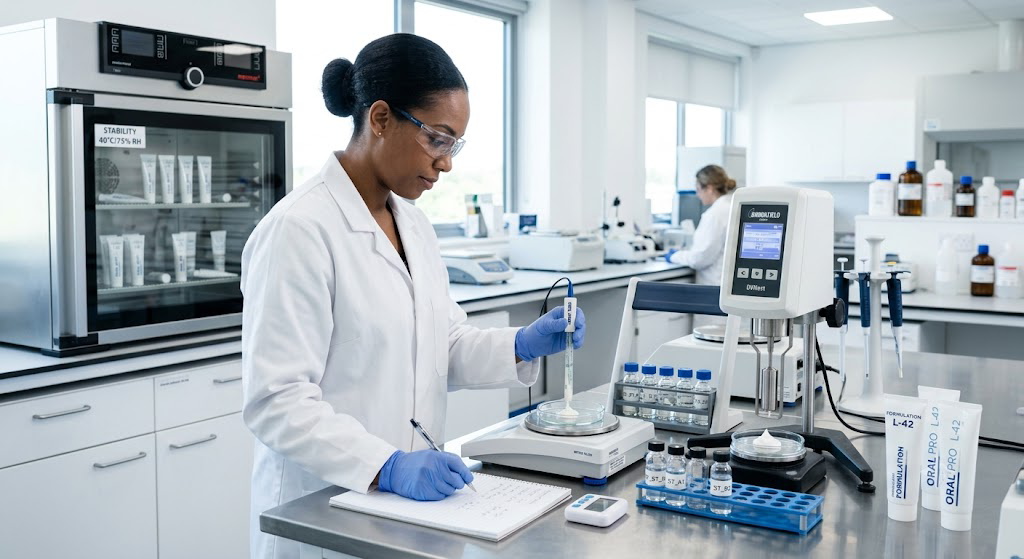
- Accelerated Stability Testing: Formulations are subjected to elevated temperatures (typically 40°C to 45°C) and controlled relative humidity (60% to 75% RH) over a 12-to-24-week period. According to the Arrhenius equation model, holding a product at 40°C for 12 weeks simulates approximately two years of storage under ambient room temperature conditions.
- Real-Time Stability Testing: Samples are monitored at standard room temperature (20°C to 25°C) for the full duration of the intended shelf life (e.g., 24 to 36 months). This ongoing study runs concurrently with commercial distribution to validate preliminary accelerated findings.
2. Thermal Stress and Freeze-Thaw Cycling
Oral hygiene products undergo extreme temperature fluctuations during shipping across different climate zones. Freeze-thaw cycling tests test the structural resilience of the binder system (such as xanthan gum or cellulose gum).
A standard freeze-thaw evaluation subjects the paste to alternating temperature extremes—typically -10°C for 24 hours, followed by 40°C for 24 hours—repeated across three to five complete cycles. If the paste exhibits weeping, phase separation, or significant viscosity shifts, the binder ratio must be reformulated.
3. Viscosity, pH, and Analytical Rheology
Physical monitoring during shelf-life studies involves precise quantitative measurement:
- pH Stability: Most toothpastes maintain a neutral to slightly alkaline pH (6.5 to 8.5) to protect dental enamel and preserve flavor integrity. Unwanted pH shifts indicate potential chemical reactions between active ingredients and flavor oils.
- Viscosity and Extrudability: A Brookfield viscometer measures the flow characteristics of the paste. The formula must remain firm enough to rest on toothbrush bristles without sagging, yet soft enough to extrude smoothly from the tube orifice.
4. Preservative Efficacy and Microbiological Screening
Because toothpastes contain water and organic humectants (such as sorbitol or glycerin), they are susceptible to microbial growth if contaminated during consumer use. Antimicrobial effectiveness testing—commonly known as Challenge Testing—evaluates whether the formulation’s preservative system effectively neutralizes introduced bacteria, yeast, and mold over time.
Packaging Interactions and Organoleptic Evaluation
A stability evaluation is incomplete without testing the product inside its final commercial container. Aluminum, laminated plastic, or recyclable polyethylene tubes can interact with flavor molecules or absorb active compounds over time.
Sensory Assessment
Organoleptic parameters evaluate human sensory perception across specific time intervals (0, 1, 3, and 6 months):
- Flavor and Aroma: Checking for oxidation or loss of mint freshness.
- Color and Appearance: Ensuring whitening agents do not cause yellowing or discoloration.
- Mouthfeel: Confirming smooth dispersion without grit or graininess.
When selecting appropriate packaging materials for commercial production, exploring specialized manufacturing solutions across modern toothpaste categories helps ensure compatible tube linings and dosing mechanisms are utilized early in the design stage.
Conclusion: Final Steps to Market Readiness
Conducting thorough toothpaste stability testing transforms shelf-life evaluation from guesswork into precise science. By combining accelerated thermal profiling, freeze-thaw cycling, pH tracking, and microbial challenge testing, oral care brands can confidently project expiration dates and verify product efficacy before hitting retail shelves. Investing in comprehensive testing upfront mitigates recall risks, satisfies global compliance standards, and guarantees exceptional consumer experiences from the first squeeze to the last.